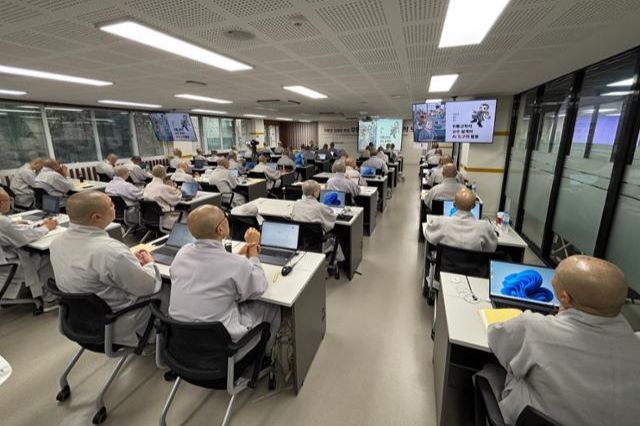
Religious communities in Korea are diving into artificial intelligence (AI) studies, marking a sharp shift from earlier years when AI was largely viewed as a threat to ethics, spirituality and human values.
As AI becomes ubiquitous in everyday life, many religious figures say faith communities must understand and use the technology wisely rather than shun it.
AI-powered chatbots and apps designed for religious use have already emerged, and efforts are underway to employ AI in scripture interpretation and theological research.
‘Nabuteo Forum,’ a Protestant group, held an AI seminar on Oct. 20, attended by leaders from various denominations and theological schools. During the event, Professor Koo Yo-han of CHA University demonstrated a worship song generated by an AI music tool.
Reactions were mixed: some said AI could become a practical tool for ministry, while others questioned whether an AI-created hymn could truly qualify as an act of faith.
‘AI can be a valuable partner if pastors use it to organize materials for ministry,’ Koo said.
The Buddhist community is also showing keen interest. On Sept. 30, the Jogye Order’s Monastic College professors gathered at Dongguk University in Seoul for a seminar titled ‘Integration of Practice, Doctrine and AI.’
Ven. Jahong introduced ‘Dharma Mitra,’ an AI platform tailored for Buddhist studies, along with new semantic search functions added to the Chinese Buddhist Electronic Text Association (CBETA) database.
From moral caution to practical adoption
For years, faith institutions largely emphasized AI’s risks — from widening social inequality to eroding moral judgment.
The Vatican highlighted the need for ethical guidelines in its 2020 ‘Rome Call for AI Ethics,’ and this year released a follow-up document titled Antiqua et Nova (‘Old and New’), urging responsible use of the technology. The World Council of Churches also warned last June that the rapid development of AI without regulation posed ‘enormous potential risks.’
Still, none of these declarations completely reject AI. Instead, they stress its ‘ethical use.’ In fact, AI adoption is already common in churches, especially within Protestant circles.
Pastors use generative AI to draft announcements, organize schedules, and even write sermons. With an aging clergy and growing concern over engaging younger ‘AI-native’ generations, many church leaders see embracing technology as a necessity.
Rev. Ryu Young-mo, head of the Na Buto Forum, said, ‘AI presents both opportunities and risks, and a gap in AI literacy could divide those who understand it from those who don’t. Churches need to learn AI actively.’
He added that his group plans a hands-on AI training session next month to help spread practical knowledge.
Maintaining purpose and authenticity
While Germany and the United States have already experimented with ‘AI pastors’ and ‘AI Jesus’ simulations, such cases remain controversial. Experts warn of the technology’s hallucination problem — generating false, vague, or overly empathetic responses.
‘AI keeps improving and speaks intelligently, but it doesn’t tell our story,’ Koo said. ‘Users must have a clear purpose when engaging AI.’
Religious leaders also caution against losing authenticity in spiritual practice. ‘Even if AI provides beautifully written sentences, overreliance could lead to mechanical preaching and detachment from the essence of the church — people and community,’ Ryu said.
Ven. Boil, director of the AI Buddhism Research Institute, echoed similar concerns during a seminar in July.
‘We must be wary of attempts to replace artistic inspiration or religious insight with AI,’ he said. ‘Especially in spiritual disciplines such as meditation, where deep inner reflection is vital, a more restrained and mindful approach is required.’
This article from the Hankook Ilbo, the sister publication of The Korea Times, is translated by generative AI and edited by The Korea Times.