Guardrails That Accelerate: Making AI Ethics Work in Practice
Raj Karan Gunukula
2 min read
· Just now
Just now
—
Listen
Share
Press enter or click to view image in full size
When we were building Amazon’s AI Growth Advisor — an intelligent assistant designed to guide millions of global sellers through personalized recommendations — the product vision was clear, but aligning everyone around AI ethics was a harder conversation. Our stakeholders spanned continents, cultures, and functions. Everyone agreed ethics mattered in principle, yet when it came to delivery, ethical guardrails were often perceived as constraints that slowed innovation.
As the technical program manager responsible for bridging science, engineering, and business, my challenge was to make AI ethics tangible — not as a compliance exercise, but as an accelerator of trust and scale. Early on, I noticed a pattern: teams viewed fairness testing, explainability, and data lineage reviews as ‘extra steps’ that risked our speed-to-market goals. My task was to reframe that mindset.
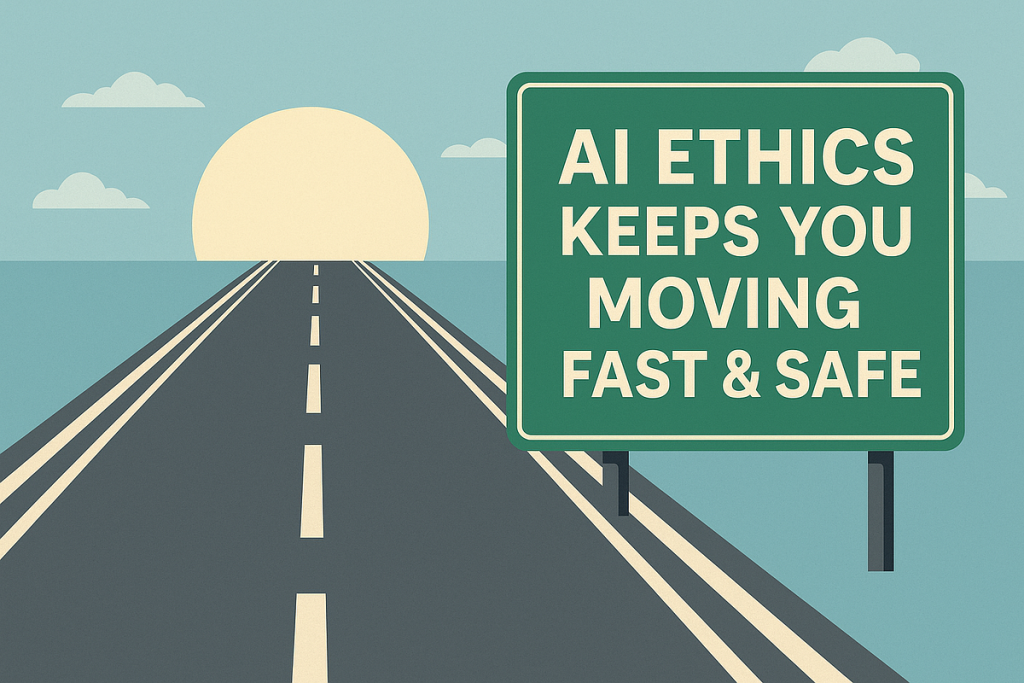
The analogy that ultimately resonated most was comparing AI ethics to highway lanes. I explained that these principles weren’t speed bumps — they were the painted lines that make high-speed travel possible. Just as lanes keep drivers from colliding while enabling them to go faster safely, ethical frameworks provide the structure that lets AI systems operate confidently at scale. Without them, speed becomes chaos; with them, velocity and safety reinforce each other.
Using this framing, we embedded ethical checks directly into our development lifecycle — bias detection in model evaluation, consent and transparency reviews in data pipelines, and human-in-the-loop controls for decision-critical actions. These became part of our ‘definition of done,’ not post-launch audits. As teams saw how structured safeguards prevented rework, reduced reputational risk, and improved product performance, skepticism gave way to advocacy.
The greatest lesson for me was that explaining AI ethics is less about abstract principles and more about shared incentives. When people see that responsible AI is not a tax on innovation but its insurance policy, they not only understand it — they champion it.