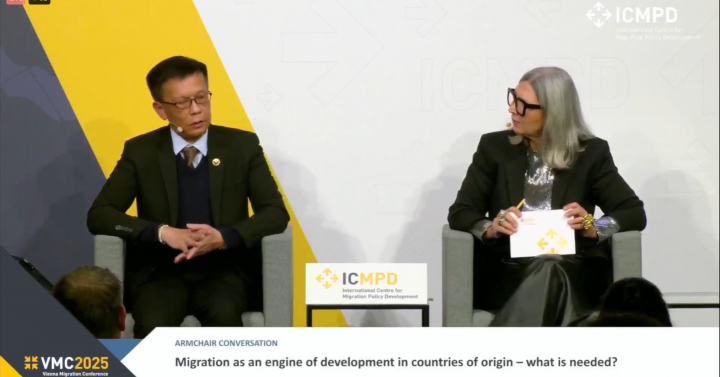
AUSTRIA CONFAB. Migrant Workers Secretary Hans Leo Cacdac (left) discusses the Philippines’ labor migration efforts, specifically its programs for overseas Filipino workers (OFWs), at the Vienna Migration Conference 2025 in Austria on Wednesday (Oct. 22, 2025). The Vienna forum, a premier platform for dialogue and exchange on migration, gathers global leaders and experts to tackle shifting migration dynamics amid economic realignments and ongoing conflicts. (Screengrab from Vienna Migration Conference livestream)
MANILA – The Philippines earned praises at a migration forum held in Vienna, Austria, reaffirming its global leadership in ethical and strategic labor migration governance and for putting the rights and welfare of overseas Filipino workers (OFWs) at the heart of its migration policies.
Sitting as a resource speaker during a high-level panel titled ‘Migration as an Engine of Development in Countries of Origin – What Is Needed?’ at the 10th Vienna Migration Conference on Wednesday, Migrant Workers Secretary Hans Leo Cacdac underscored that the Philippines’ migration framework is built on three pillars that include protection, empowerment, and reintegration, ensuring that OFWs are supported before departure, while abroad, and upon their return.
He said the Philippines’ approach to labor mobility is not about exporting labor, but empowering people through protection, skills, and opportunity.
‘We have a strong legal heritage and history of compassion insofar as labor is concerned. We have a 90-year-old constitutional provision that was reiterated in subsequent versions of our Constitution, 1935. We vowed to protect labor, a forward protection to labor clause in our Constitution. We’re one of the first, as I understand, to put this in our supreme law,’ Cacdac said.
He said the Philippines’ development policy is not exporting labor, but rather, the OFWs themselves are the ones who create employment opportunities abroad, especially with the reputation of Filipino workers as compassionate and hard-working.
‘Our role is to ensure that deployment is rights-based, welfare-focused, and development-oriented for the worker and for the nation,’ he added.
Cacdac highlighted the Philippines’ strong and comprehensive labor migration framework, stressing the country’s steadfast dedication to protecting, empowering, and supporting Filipino migrant workers throughout their migration journey.
He also stressed that when labor mobility is responsibly and strategically managed, it serves as a catalyst for inclusive growth, international cooperation, and the preservation of migrant dignity.
Cacdac said the Philippines’ Department of Migrant Workers’ (DMW’s) rights-based system is anchored on ethical recruitment, quick welfare response mechanisms, and lifelong learning programs that equip workers with skills in digital literacy, language proficiency, and global standards certification.
He said these initiatives help OFWs succeed abroad while safeguarding their rights and preparing them for reintegration at home.
Meanwhile, Cacdac also underscored the importance of strong bilateral cooperation with countries hosting OFWs.
‘International cooperation back as far back as the 1970s and the 80s we’ve been talking to countries hosting OFWs, Saudi Arabia, Kuwait in the Middle East of course, and in Asia, with the ASEAN, our Southeast Asian grouping, and there we have laid the basis for discussions on how else to enhance labor mobility in terms of safety and ethical recruitment, as well as protection of our nationals abroad,’ Cacdac said
‘Needless to say, a combination of all these factors, whether it’s protection, whether it’s regulation or skills development, if you combine all of those, we laid the basis for successful OFW integration.”
Cacdac said that for the Philippines, skills and welfare protection go hand in hand, and so, the Philippines also invests in lifelong learning and future skills because preparation is protection.
‘When workers are skilled and informed, they are empowered,’ he added.
At the conference, participants lauded the Philippines as a model for other labor-sending nations, with one delegate calling it ‘a superpower among labor-sending countries.’
Cacdac said the recognition highlights the country’s growing influence in shaping humane and sustainable migration policies worldwide. (PNA)